
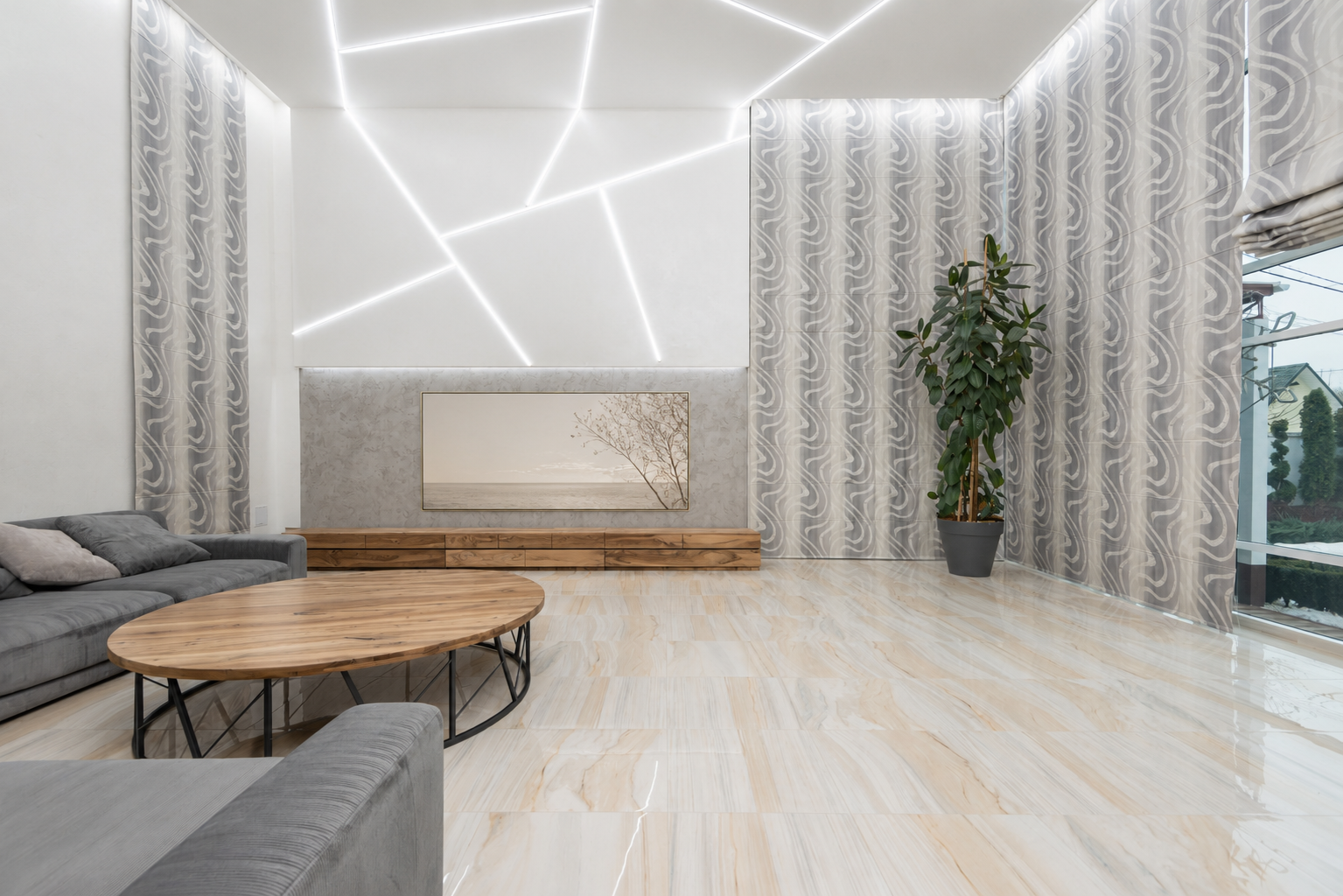
For years, the smart home was presented as a collection of connected objects: lights controlled from a phone, voice-operated appliances and screens occupying every available surface. The result did not always feel particularly intelligent — or beautiful.
A different idea is now emerging. Rather than asking how much technology can be added to a home, designers are considering how it should inhabit one. Should it remain visible, blend into the architecture or move naturally through our rooms?
Three products presented in 2026 suggest that the smart home’s next evolution will be defined by a more harmonious relationship between technology, people and space.
The Robot Enters the Domestic Landscape
The idea of a robot taking care of household tasks has existed in popular culture for decades. With LG CLOiD, that familiar vision begins to acquire a physical presence.
Presented at CES 2026, CLOiD is an AI-powered robot with a wheeled base, articulated arms and five-fingered hands. During demonstrations, it retrieved food from a refrigerator, used an oven, managed laundry and folded clothes. Connected to LG’s ThinQ ecosystem, it is designed to interact not only with people but also with the appliances around it. LG’s presentation describes this as part of a “Zero Labor Home”: a domestic environment where machines take over repetitive tasks.
Yet the most interesting aspect of CLOiD may not be what it can do, but how it changes the perception of technology in the home. Unlike a hidden algorithm or a disembodied voice assistant, the robot occupies space. It moves among furniture, objects and people, becoming part of the domestic landscape.
This creates new design questions. How large should a home robot be? Should it resemble a person, an appliance or something entirely different? And how comfortable are we with a device equipped with cameras and sensors moving through our most private spaces?
The technology is still evolving, but its arrival suggests that the smart home may soon become less about controlling devices and more about sharing space with them.
The Screen Becomes Architecture
While robots are becoming more physically present, screens are moving in the opposite direction: closer to disappearing.
The LG OLED evo W6, introduced as the Wallpaper TV, is only around nine millimetres thick and sits almost flush against the wall. A separate wireless box transmits video and audio, reducing the need for visible cables and external devices. Rather than appearing as a conventional television, the screen behaves more like an architectural surface.
This reflects a broader transformation in interior technology. The television has long been one of the most visually dominant objects in a living room, often determining the position of sofas, lighting and furniture. Ultra-thin and wireless displays challenge that hierarchy. When switched off, the screen can recede into the room rather than remaining its permanent focal point.
The goal is no longer simply to make screens larger or brighter. It is to make them less disruptive — capable of delivering a digital experience without visually overwhelming the physical environment.
Technology Becomes More Flexible
Samsung’s The Freestyle+ offers another interpretation of this changing relationship. Instead of fixing a screen permanently to a wall, the compact projector allows images to appear where and when they are needed.
Its AI-powered system automatically adjusts the projection to different surfaces, including walls, ceilings and curtains. This transforms almost any part of a room into a temporary screen, without requiring a permanent installation.
The idea is subtle but significant. A home no longer needs to be organised around technology. Technology can adapt to the home.
A bedroom ceiling can become a cinema for an evening. A blank wall can host a workout session and return to being empty afterwards. Digital functions are present when useful, then disappear when they are not.
This flexibility responds to the way contemporary spaces are increasingly used: the same room may function as an office, living area, gym and place of rest at different moments of the day.
From Smart Objects to Responsive Spaces
CLOiD, the Wallpaper TV and The Freestyle+ represent different stages of the same transition. One gives artificial intelligence a body. Another integrates the screen into the architecture. The third frees digital content from a fixed location.
Together, they point towards homes that are not simply filled with connected products, but capable of adapting to human routines and spatial needs.
The real measure of progress may therefore be less visible than expected. The most successful domestic technology will not necessarily be the device that attracts the most attention. It may be the one that understands when to appear, how to assist and when to quietly recede into the background.
The future smart home may not look more technological. It may simply feel more natural.