
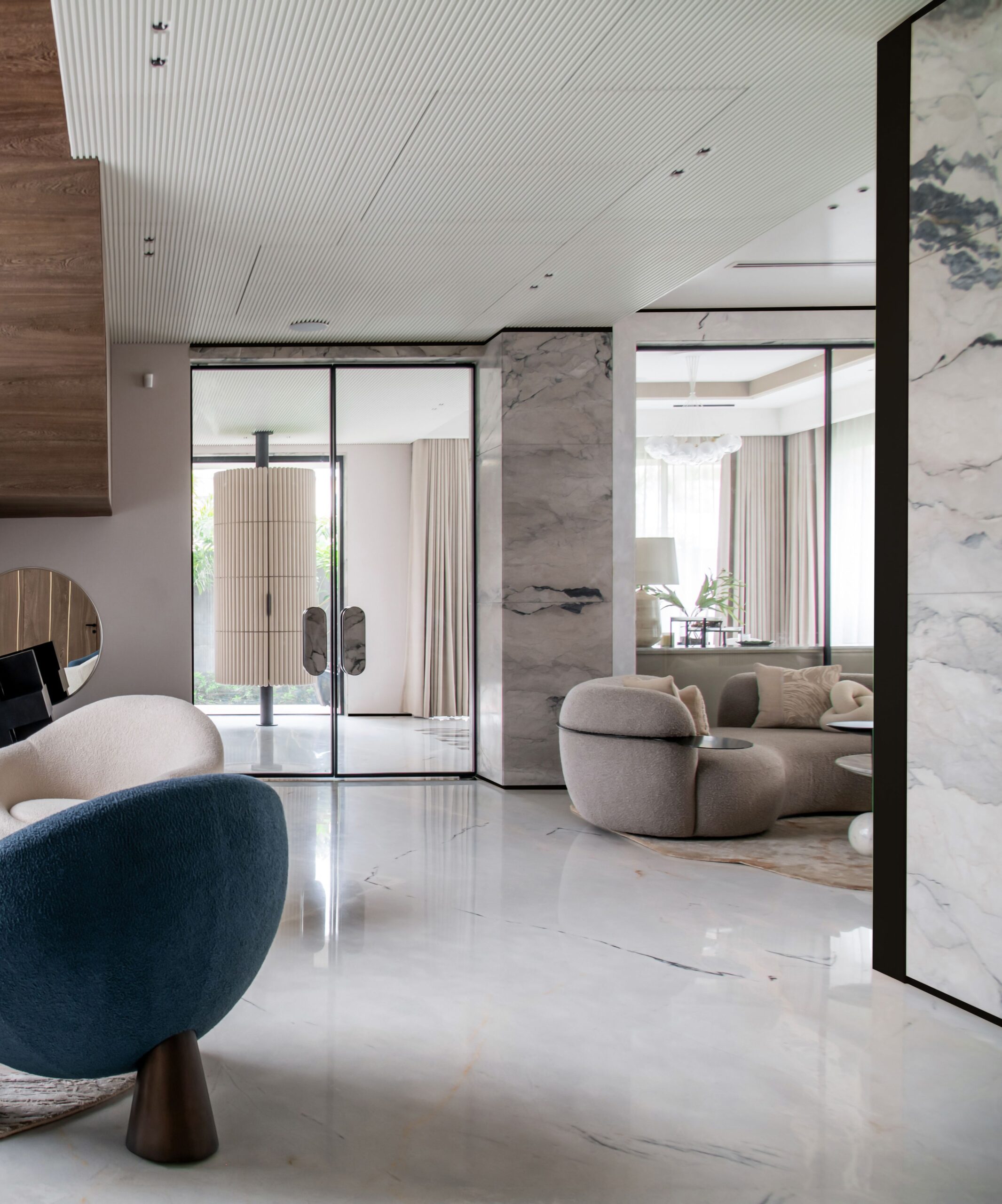
There is a particular kind of magic that happens when you walk into a room and feel that everything is perfectly right — the light is exactly warm enough, the air is exactly the right temperature, soft music seems to radiate from the very walls — and yet you cannot see a single device, panel, cable, or screen. No glowing keypads. No clusters of switches. No black rectangle dominating the wall where a painting should be. The room breathes, and it breathes intelligently.
This is the defining ambition of contemporary luxury residential design: a home that is smarter than anything that came before it, and yet shows no evidence of it whatsoever.
The shift is neither subtle nor accidental. For years, smart home technology was worn as a badge of modernity — the more visible, the better. Oversized touchscreens mounted on walls, illuminated control panels in every corridor, and a proliferation of devices that announced themselves loudly in rooms carefully curated to whisper. Today, the most sophisticated homes in the world have reversed that logic entirely. The best technology is the technology you never see.
The Philosophy of Disappearance
The interior designers and architects working at the highest levels of the market have begun to articulate what they call a unified design philosophy around invisibility. The principle is deceptively simple: technology should serve the architecture, never compete with it. When a lighting control keypad is flush with the wall, finished in the same plaster and tinted the same tone as the surrounding surface, it stops being a device and becomes, simply, the wall. When motorized shading disappears into a recessed pocket engineered into the ceiling during the framing phase, the window remains a window — a view, a frame, a relationship with light — rather than a mechanical system.
This approach demands a radical rethinking of how and when technology enters the design process. The invisible smart home cannot be an afterthought. It must be conceived at the blueprint stage, before a single wall is built, before a single cable is routed. Architects, interior designers, and technology integrators must collaborate from the very first sketch, designating space for equipment rooms, planning wiring infrastructure, and engineering the precise locations of hidden sensors so that the finished surfaces remain inviolate. Projects that treat technology as a final layer — something to be installed after the beautiful rooms are already done — will always betray their ambitions. The invisible smart home is not a product. It is a construction method.
Sound That Comes From Nowhere
Of all the elements that define the sensory experience of a luxury home, audio is among the most intimate — and historically, the most visually disruptive. Floor-standing speakers demand floor space and visual attention. Even conventional in-wall speakers leave visible grilles that interrupt the continuity of a painted wall or a stretch of custom wallpaper. The solution emerging at the top of the market is acoustic technology so refined it borders on the theatrical.
Speakers are now manufactured to be installed flush with the drywall and then plastered, sanded, and painted over entirely. The finished surface gives no indication of what lies beneath. What the technology achieves through vibrating acoustic panels is a sound that seems to emanate from the architecture itself — from the room, as if the room were the instrument. Audiophiles initially resisted the premise, but the acoustic engineering behind these systems has advanced to the point where high-fidelity performance is no longer sacrificed for aesthetic purity. The music arrives, full and present, and the source remains beautifully mysterious.
Television presents a parallel challenge. The flat screen — particularly large-format displays — has long been the adversary of the interior designer: a necessary intrusion, a black void on the wall that refuses to participate in the visual composition around it. Contemporary solutions address this with elegance. Mirror-finish televisions, indistinguishable from decorative mirrors when switched off, reveal themselves as ultra-high-definition displays only when activated. Motorized artwork — paintings and photographic prints mounted on silent mechanisms — roll away on command to expose screens concealed behind them, then return, seamlessly restoring the room to its curated state. The television exists in the house without residing in it.
Light as Architecture
Lighting design has always been one of the most powerful tools in an interior designer’s vocabulary, but managing it has traditionally required a proliferation of switches that fragment the visual rhythm of a room. In a well-appointed space, you might have six or seven separate lighting circuits — ambient, accent, task, decorative — each demanding its own control point. The result, historically, was a wall lined with panels that turned a design statement into an electrical panel.
Centralized lighting systems resolve this by relocating all the hardware — the dimmers, the processors, the switching modules — to a dedicated mechanical room hidden from view. In the living spaces, control is reduced to a single flush-mounted keypad, finished in brushed brass, aged bronze, or matte plaster to match the room’s material palette. A single gesture activates a complete lighting scene: the ambient levels soften, the accent lighting sharpens on the art, the table lamp beside the sofa warms to a glow that corresponds to the hour of evening. The technology performs the choreography; the room takes the credit.
Systems like Lutron’s Ketra go further still, replicating the natural arc of daylight throughout the day — shifting the color temperature of artificial light to follow the logic of the sun, even in rooms without windows. The effect on the body is documented and significant: circadian rhythms supported, sleep quality improved, the subtle stress of inconsistent lighting eliminated. Here, technology and wellness converge so completely that they become indistinguishable from good design.
Climate as Atmosphere
The traditional thermostat — a small plastic rectangle on the wall, always slightly wrong for the room, always slightly wrong for the décor — has become the emblem of everything the invisible smart home seeks to overcome. Designers have a name for the visual problem it creates alongside other wall-mounted devices: “wall acne.” The aggregation of controls that interrupt the surface of a beautifully considered interior.
The response is a distributed network of sensors so small they can be painted into the wall surface or concealed behind trim. These sensors read occupancy, temperature, humidity, and light levels across every room, feeding data to a centralized processor that maintains comfort without ever requiring a visible interface. Air delivery itself is being reconsidered: traditional louvered metal grilles are giving way to architectural diffusers — narrow, shadow-like slits integrated into plaster ceilings — that circulate conditioned air without announcing their presence. The climate of the room is managed invisibly, continuously, and with a precision that manual adjustment can never match.
Intelligence That Learns You
What separates the new generation of smart homes from their predecessors is not the sophistication of any individual device but the emergence of genuine system intelligence. Artificial intelligence, now integrated into the most advanced residential automation platforms, transforms the home from a collection of automated functions into something that behaves like a considered, attentive presence.
The system learns. It observes that you lower the shading on the western elevation at a particular hour when the afternoon light becomes harsh. It notes that you prefer a cooler sleeping environment on weeknights and a warmer one on weekends. It understands, through the pattern of your mornings, that coffee is usually followed by twenty minutes of reading, followed by departure, and it prepares the house accordingly — adjusting light, temperature, and music in a sequence so seamlessly calibrated that it never rises to the level of conscious notice. You do not manage the house. The house manages itself, around you.
This predictive intelligence remains entirely invisible precisely because it asks nothing of you. There are no prompts, no notifications, no moments where the technology insists on making itself known. The home simply becomes, progressively, more itself — more attuned, more responsive, more quietly extraordinary. The AI operates locally, on processors housed in the mechanical room, ensuring that the privacy of the home’s inhabitants is protected as rigorously as its aesthetic integrity.
How would you feel in a home that anticipates your gestures, without asking anything?
Interested in partnering with Zayra Living?
We welcome selected collaborations with brands, destinations and design-led spaces aligned with our editorial vision.
For partnership enquiries, contact hello@zayraliving.com