
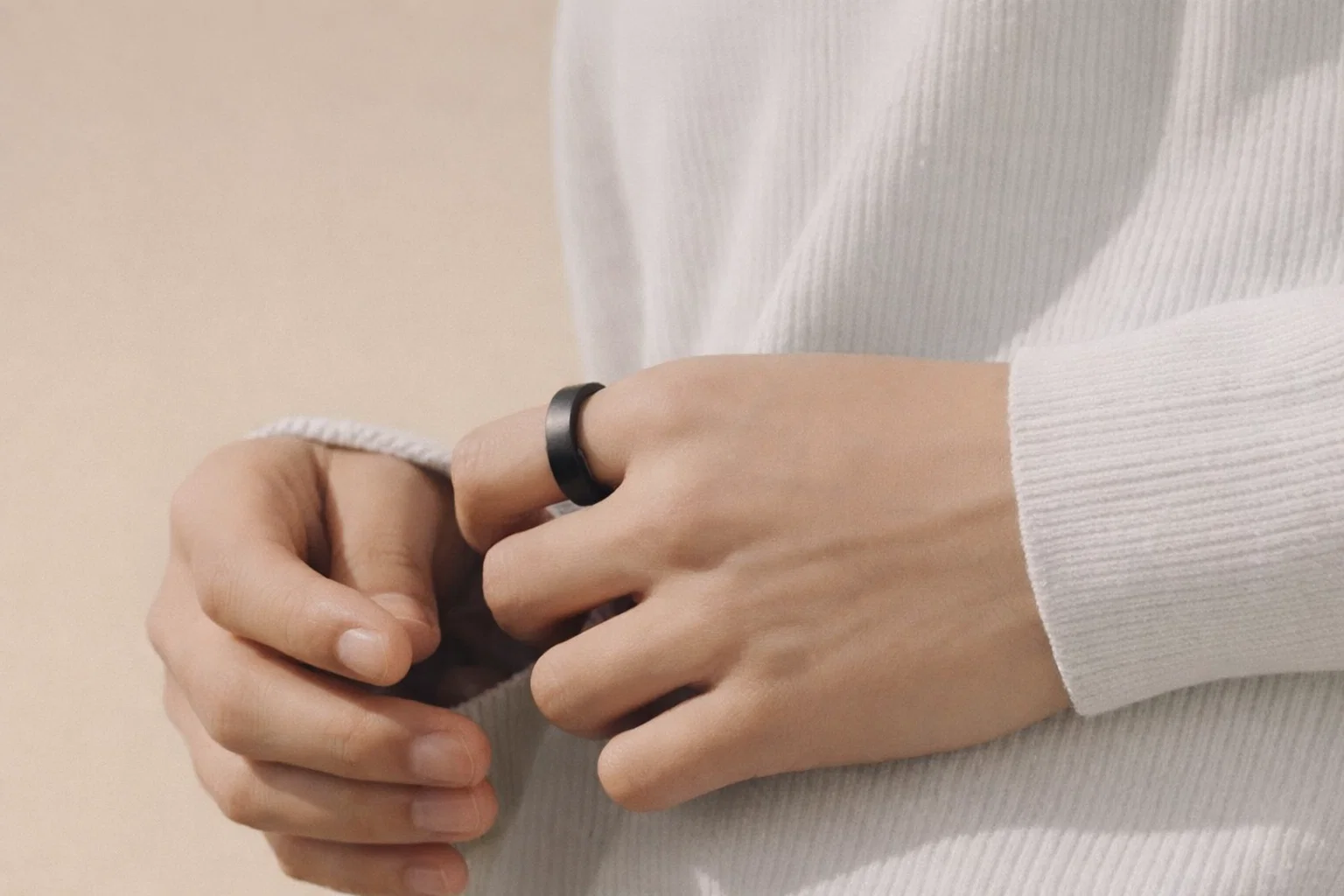
There was a precise moment when technology stopped living in our pockets and started living on our bodies. In 2026, that moment took the shape of a ring. Global smart ring shipments grew 49% in a single year, outpacing smartwatch growth — held at 4% according to Counterpoint Research — with the smart ring figure coming from IDC, which shared its data with Bloomberg in January 2026. Oura Ring dominated the category, holding 80% of the market in 2023, a share that the arrival of the Samsung Galaxy Ring — with all features included and no monthly subscription — has begun to erode. At CES 2026, the J-Style JCRing added clinical blood oxygen monitoring designed for remote patient management. Heart rate, HRV variability, skin temperature, sleep quality, and stress levels: all of this now lives in a few grams of titanium on your finger.
The Glasses That See More
The smart glasses market grew 110% in the first half of 2025. Meta holds 73% of global sales with its Ray-Ban Meta, which integrate an AI assistant capable of translating in real time, answering questions about what the user is looking at, and capturing photos and videos with a voice command. At Meta Connect in September 2025, Meta unveiled the Ray-Ban Display at $799, featuring a monocular display integrated into the lens alongside the Neural Band — a wristband that reads the electrical signals generated by muscle activity in the wrist, via EMG (electromyography) technology, to control the glasses without touching them. At CES 2026, Meta then announced new features for the already-available product, including a teleprompter mode and gesture-based handwriting. Google is developing its own response, focusing on lenses with augmented reality overlaid onto the real environment.
The Body as Dashboard
The most significant innovations concern sensors. Withings unveiled BodyScan 2 at CES 2026, a smart scale that measures over 60 biomarkers in 90 seconds — from segmented body composition to early vascular risk — and is currently awaiting FDA clearance. Bioconnect showcased VitalTracker, winner of the CES 2026 Innovation Award, a device that reads blood pressure and vital parameters by analyzing facial blood flow through a camera, with no physical contact required. Eli Health developed the Hormometer — introduced at CES 2025 and awarded the Best of Innovation Award at that edition — the first home device for rapid hormonal monitoring via a simple saliva sample: it tracks cortisol and progesterone, delivering results in approximately 20 minutes, with no lab visits or blood draws needed. Luna Band, a screenless wristband priced at $149 and unveiled at CES 2026, operates entirely through Siri voice commands: users narrate their day, and its AI engine contextualizes the biometric data accordingly.
Fabric Becomes Intelligent
In February 2026, a study published in Nature Communications by King’s College London demonstrated that sensors sewn onto loose fabric track movement with 40% greater accuracy than sensors adhered directly to the skin, while requiring 80% less data. Loose fabric acts as a natural mechanical amplifier. At Rice University, a $24 million Canadian dollar project is developing garments with actuators integrated directly into the fibers: leggings that assist with balance, sleeves that support arm movement, fabrics that change stiffness in response to the body. The stated goal is to create clothing that can be machine-washed and looks entirely like ordinary apparel.
Where We’re Headed
What emerges from 2026 is a clear trajectory: wearable technology is becoming invisible, clinical, and predictive. It no longer merely collects data — it interprets, anticipates, and transforms data into action. On-device artificial intelligence processes everything locally, without the cloud, and Qualcomm has just launched the Snapdragon Wear Elite at MWC 2026 to power this transition. The wearable health technology market is estimated to reach $169 billion by 2029. The question is no longer whether technology will accompany us everywhere. It’s whether we’ll still be able to tell it apart from ourselves.
Interested in partnering with Zayra Living? Get in touch!
Write to hello@zayraliving.com
This article contains affiliate links. When you book through our links, we receive a small commission at no extra cost to you. This helps us create free, quality content.